For years, marketing has relied on rules. Segment your audience. Send a timed email. Trigger a campaign based on basic behaviors. It worked… sometimes. But as consumers demand more relevance and immediacy, rules-based systems start to show their limitations. They’re reactive, rigid, and ultimately, slow.
Enter AI-powered decisioning. This isn’t just automation—it’s intelligent, real-time personalization at scale. AI can process trillions of signals—everything from customer behaviors and purchase history to context like time of day, location, or device type. In milliseconds, it recommends the next best action for every individual, transforming how marketers engage audiences.
Here’s why it matters and how to make it work:
1. Build a Rock-Solid Data Foundation
AI is only as smart as the data it consumes. Collecting data isn’t enough—you need clean, structured, and connected data that gives a full view of your customer. First-party data is gold. Tie together:
- CRM recordsWebsite and app interactionsTransactional and purchase historyEngagement metrics from email, ads, or social media
CRM records
Website and app interactions
Transactional and purchase history
Engagement metrics from email, ads, or social media
Next, make sure these datasets are integrated and accessible to your AI systems. The goal is a single customer view, where every signal contributes to smarter decisions. Without this, AI recommendations will be limited, inconsistent, or inaccurate.
2. How AI Comes Into Play
AI sits between your data and your campaigns, acting as the brain of your marketing ecosystem. Here’s where it powers real value:
- Analyzing Data – AI consumes unified data from your warehouse and CDP:Detects patterns in customer behaviorUnderstands trends and preferences in real timeRecognizes context like location, device, or timePredicting Outcomes – Machine learning models forecast:Which customers are most likely to buy, churn, or engageWhich product, message, or offer will resonate bestOptimal timing for each interaction across channelsRecommending Actions – Decision engines turn predictions into action:Trigger personalized campaigns in email, SMS, push, web, or adsSuggest next-best-action for sales or service teamsPrioritize customer segments for targetingOptimizing Continuously – AI adapts and improves over time:Models update as new data comes inCampaigns adjust dynamically based on engagementFeedback loops increase accuracy and ROI
Analyzing Data – AI consumes unified data from your warehouse and CDP:
- Detects patterns in customer behaviorUnderstands trends and preferences in real timeRecognizes context like location, device, or time
Detects patterns in customer behavior
Understands trends and preferences in real time
Recognizes context like location, device, or time
Predicting Outcomes – Machine learning models forecast:
- Which customers are most likely to buy, churn, or engageWhich product, message, or offer will resonate bestOptimal timing for each interaction across channels
Which customers are most likely to buy, churn, or engage
Which product, message, or offer will resonate best
Optimal timing for each interaction across channels
Recommending Actions – Decision engines turn predictions into action:
- Trigger personalized campaigns in email, SMS, push, web, or adsSuggest next-best-action for sales or service teamsPrioritize customer segments for targeting
Trigger personalized campaigns in email, SMS, push, web, or ads
Suggest next-best-action for sales or service teams
Prioritize customer segments for targeting
Optimizing Continuously – AI adapts and improves over time:
- Models update as new data comes inCampaigns adjust dynamically based on engagementFeedback loops increase accuracy and ROI
Models update as new data comes in
Campaigns adjust dynamically based on engagement
Feedback loops increase accuracy and ROI
3. Start Small, Then Scale
The temptation is to deploy AI everywhere at once. Don’t. Start with a high-impact area: a single customer journey, product line, or campaign type. For example:
- Personalizing product recommendations on your websiteOptimizing email send times and content based on engagement patternsTriggering offers for at-risk customers
Personalizing product recommendations on your website
Optimizing email send times and content based on engagement patterns
Triggering offers for at-risk customers
Focus on a controlled, measurable scope, refine the models, and then expand to other channels and segments. Scaling too fast can dilute performance and make AI adoption harder to manage.
4. Make AI Decisions Explainable
AI works best when your team trusts it. That means having transparent models that show why a particular action is recommended. For marketing, this can include:
- Confidence scores for predicted actionsVisibility into which signals influenced a recommendationAlerts for anomalies or unexpected outcomes
Confidence scores for predicted actions
Visibility into which signals influenced a recommendation
Alerts for anomalies or unexpected outcomes
Explainable AI not only helps your team make better decisions, but also builds trust with customers and regulators.
5. Embed Testing and Iteration
AI decisioning is not set-it-and-forget-it. To ensure performance, you need to continuously test and measure:
- Conduct A/B or multivariate testing for recommendationsTrack conversion lift, engagement, and revenue impactMonitor accuracy of AI predictions and adjust models accordingly
Conduct A/B or multivariate testing for recommendations
Track conversion lift, engagement, and revenue impact
Monitor accuracy of AI predictions and adjust models accordingly
Think of AI as a continuous improvement engine. The more feedback loops you build in, the smarter your system gets—and the more value it delivers over time.
6. Align AI With Business Objectives
AI should never exist in a vacuum. Tie recommendations to clear, measurable outcomes like:
- Revenue lift from product recommendationsReduced churn from retention campaignsIncreased engagement through personalized messaging
Revenue lift from product recommendations
Reduced churn from retention campaigns
Increased engagement through personalized messaging
Define your KPIs before deployment, and ensure your AI strategy is directly linked to business priorities.
7. Don’t Forget the Human Touch
AI can process trillions of signals, but humans bring context, empathy, and creativity. Treat AI as a decision-support tool, not a replacement. Marketing teams should:
- Validate AI recommendations against real-world experienceIdentify opportunities where AI lacks nuanceMake strategic decisions based on both data and judgment
Validate AI recommendations against real-world experience
Identify opportunities where AI lacks nuance
Make strategic decisions based on both data and judgment
This hybrid approach ensures campaigns feel human, even when powered by machines.
8. Keep Ethics and Privacy Front and Center
Customers and regulators are watching closely. Ensure your AI strategy:
- Complies with data privacy laws (GDPR, CCPA, etc.)Uses anonymized or pseudonymized data when possibleProvides transparency to customers on how their data is used
Complies with data privacy laws (GDPR, CCPA, etc.)
Uses anonymized or pseudonymized data when possible
Provides transparency to customers on how their data is used
Ethical AI is not just about compliance—it’s a competitive advantage.
9. The Tech Stack That Makes It Possible
AI decisioning isn’t just models—it’s a full-stack ecosystem. Here’s an example of a modern tech stack:
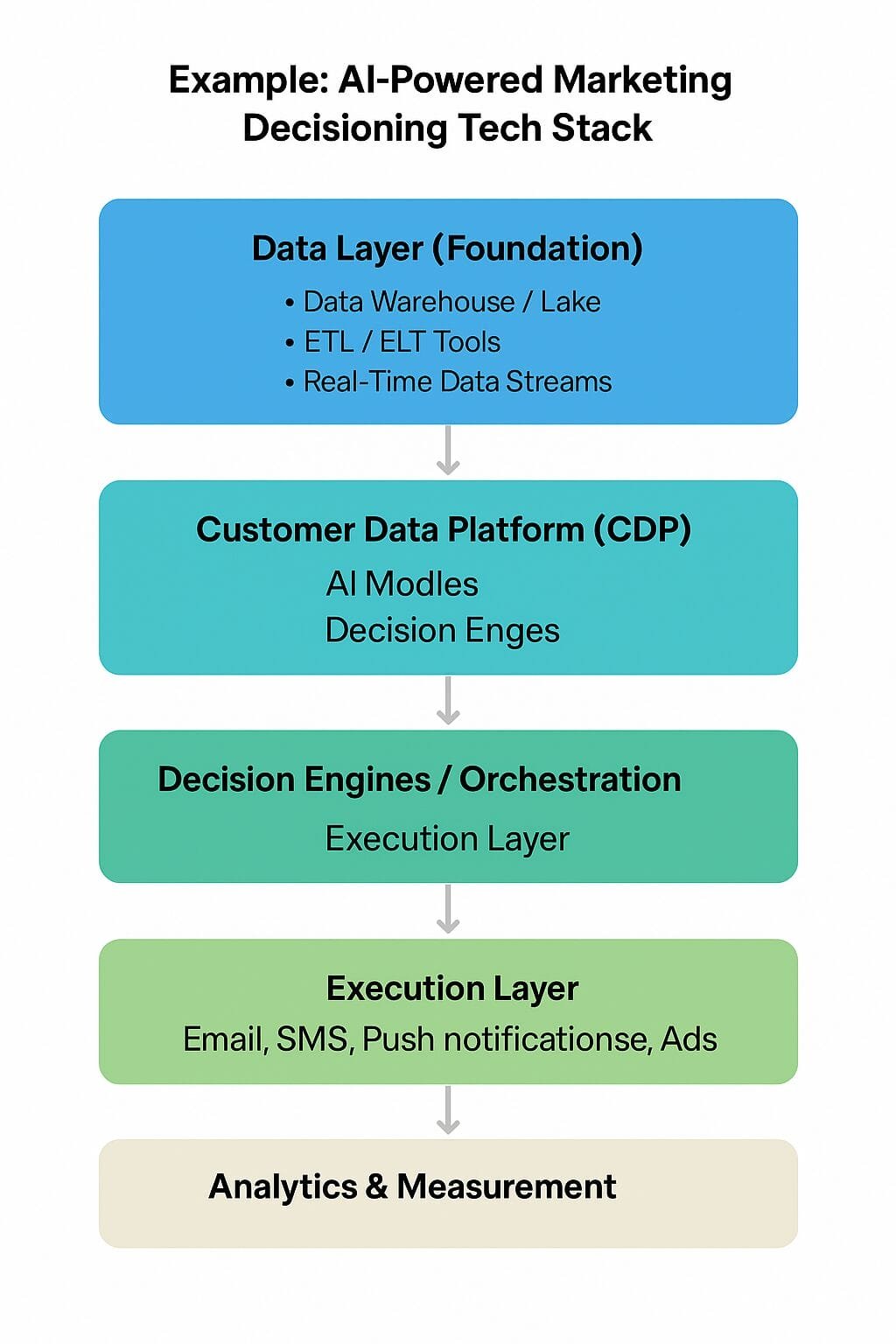
Layers include:
- Data Layer: Centralized warehouse/lake, ETL/real-time pipelinesCustomer Data Platform (CDP): Unified customer profiles for personalizationAI & Machine Learning: Predictive models, decision engines, campaign executionAnalytics & Measurement: BI tools, web/app analytics, attributionIntegration & API Layer: Smooth data and campaign orchestrationGovernance & Privacy: Consent management, DLP, auditabilityOptional Enhancements: Experimentation platforms, feedback loops, dashboards
Data Layer: Centralized warehouse/lake, ETL/real-time pipelines
Customer Data Platform (CDP): Unified customer profiles for personalization
AI & Machine Learning: Predictive models, decision engines, campaign execution
Analytics & Measurement: BI tools, web/app analytics, attribution
Integration & API Layer: Smooth data and campaign orchestration
Governance & Privacy: Consent management, DLP, auditability
Optional Enhancements: Experimentation platforms, feedback loops, dashboards
How AI interacts with the stack:
- Data flows in from multiple sources into the warehouse/CDPAI models analyze the unified data in real-timeDecision engines trigger campaigns or suggest next-best-actionsAnalytics feed back performance data to refine modelsGovernance ensures privacy, compliance, and explainability
Data flows in from multiple sources into the warehouse/CDP
AI models analyze the unified data in real-time
Decision engines trigger campaigns or suggest next-best-actions
Analytics feed back performance data to refine models
Governance ensures privacy, compliance, and explainability
Transitioning from rules-based campaigns to AI-powered decisioning isn’t just a tech upgrade—it’s a marketing evolution. Brands that build a strong data foundation, start small, integrate AI thoughtfully, measure continuously, and maintain human oversight will:
- Deliver personalized experiences at scaleMake smarter decisions fasterDrive measurable business impact
Deliver personalized experiences at scale
Make smarter decisions faster
Drive measurable business impact
AI isn’t optional—it’s quickly becoming the baseline for competitive marketing. The brands that get this right will leave the rest of the market trying to catch up.